SERVICE · VERTICAL TRANSPORTATION
COMMERCIAL ELEVATOR ELECTRICAL
MACHINE ROOM POWER · CONTROLLERS & DRIVES · HOISTWAY WIRING · FIRE SERVICE · EMERGENCY POWER
OVERVIEW
WHAT WE DO
Elevator electrical is its own discipline inside the electrical code, and it is treated that way. NEC Article 620 governs the feeder, the disconnecting means, the motor branch circuit, the traveling cable, and the hoistway and pit circuits — and ASME A17.1 sits on top of it with the mechanical and life-safety requirements the inspector will actually test. Lightning Mobile Electric performs the electrical scope on commercial elevator installations, modernizations, and repairs: dedicated feeders and lockable disconnects, controller and drive power, traveling cable and cab wiring, hoistway lighting and pit receptacles, fire service recall interface, and standby power coordination. We work alongside elevator contractors rather than against them, and we scope to the inspection instead of discovering it at the end.
CAPABILITIES
SCOPE OF SERVICE
MACHINE ROOM POWER & DISCONNECTING MEANS
Every elevator needs a dedicated feeder, a disconnecting means within sight of the controller, and a motor branch circuit sized to the actual drive and machine — not to a rule of thumb. We install feeders from the service or house panel to the machine room, set lockable disconnects with the required interrupting rating, land the motor branch circuit, and provide the separate circuit the code requires for machine room lighting and receptacles. In existing buildings we verify available capacity before anyone orders equipment.
- • Dedicated elevator feeder from service or house panel
- • Lockable disconnecting means located per NEC 620
- • Motor branch circuit and overcurrent sizing to the drive
- • Machine room lighting and receptacle circuits
- • Voltage drop verification on long machine room runs
- • Grounding and bonding of machine room equipment
CONTROLLERS, DRIVES & POWER QUALITY
Modern elevator controllers run on variable-voltage variable-frequency drives, and those drives bring harmonic distortion, regenerative energy, and heat into a room that was often designed for relay logic. We power controllers correctly, coordinate line reactors and filters where harmonic levels threaten other equipment on the service, and address regenerative drives that push energy back onto the building distribution. Controller replacement and drive retrofits are scoped with the elevator contractor so the electrical work lands before the controller does.
- • Controller and drive power termination
- • Line reactors, filters, and harmonic mitigation
- • Regenerative drive coordination with building distribution
- • Controller replacement and drive retrofit power scope
- • Machine room cooling and ventilation circuit support
- • Dedicated grounding for drive and control equipment
TRAVELING CABLE, CAB & HOISTWAY WIRING
The traveling cable is the hardest-working conductor in the building — it flexes with every trip the car makes, and it fails at the point where it is clamped and flexed. We install and replace traveling cables, terminate cab fixture wiring for call stations, car lighting, position indicators, and ADA-compliant communication, and handle hoistway wiring including pit lighting, the pit receptacle, sump pump circuit, and hoistway access switches. All of it is supported and protected to the code requirements for the location.
- • Traveling cable installation and replacement
- • Cab fixture and car lighting wiring
- • ADA car communication and emergency phone circuits
- • Hoistway lighting, pit lighting, and pit receptacle
- • Pit sump pump circuit and hoistway access switches
- • Counterweight and compensation chain clearance coordination
FIRE SERVICE & LIFE-SAFETY INTERFACE
Fire service recall is where elevator electrical and fire alarm meet, and it is the item most often found wrong at inspection. We wire Phase I and Phase II recall, coordinate the hoistway and machine room smoke detectors with the fire alarm contractor, and verify the recall sequence actually returns the car to the designated landing. Where the code path requires it, we install and verify shunt-trip protection for the elevator power circuit so a sprinkler activation removes power in the intended sequence rather than trapping riders.
- • Phase I and Phase II fire service recall wiring
- • Hoistway and machine room detector interface
- • Shunt-trip coordination with sprinkler and alarm scope
- • Fireman's hat switch and key switch circuits
- • Recall sequence verification with the elevator contractor
- • Documentation for the annual inspection
EMERGENCY POWER & BATTERY LOWERING
Standby power to an elevator is a life-safety function, not a convenience. We connect the elevator to generator or ATS-backed circuits, verify the transfer sequence actually picks up the drive without faulting, and install battery lowering where the design calls for the car to travel to the nearest landing and open its doors on power loss. We test it under load — an emergency power circuit that has never carried the elevator is an assumption.
- • Generator and ATS connection to elevator circuits
- • Transfer sequence and drive ride-through verification
- • Battery lowering device power and testing
- • Car emergency lighting and alarm battery circuits
- • Load testing and documented runtime
- • Annual re-verification under a maintenance program
MODERNIZATION, RETROFIT & NEW INSTALL
Machine-room-less and modern traction equipment changes what the electrical scope looks like — smaller controllers, different feeder requirements, and destination dispatch systems that need network infrastructure in the hoistway and lobby. We handle the electrical side of modernizations and new installations: power for MRL controllers, destination dispatch kiosk and riser cabling, lobby and hall fixture power, and the coordination with the general contractor that keeps the electrical inspection from becoming the last item on the schedule.
- • Machine-room-less controller power and access
- • Destination dispatch kiosk and riser cabling
- • Hall call station and lobby fixture wiring
- • Elevator pit waterproofing and drainage circuits
- • GC and elevator contractor coordination
- • Inspection scheduling and punch list close-out
TECHNICAL SPECIFICATIONS
THE SPEC SHEET BEHIND THE SCOPE
Every line below is an item we size, install, or verify in writing on a commercial elevator electrical scope. It is also the list the inspector walks through — so we treat it as the deliverable, not the fine print.
POWER & DISTRIBUTION
- SERVICE VOLTAGE
- 208V / 240V / 480V · 3-phase
- ELEVATOR FEEDER
- Dedicated, no taps — NEC 620.24
- DISCONNECTING MEANS
- Lockable, within sight of controller
- MOTOR BRANCH CIRCUIT
- Sized to drive input current, not motor FLA alone
- GROUNDING & BONDING
- Equipment ground plus isolated drive ground
- MACHINE ROOM CIRCUITS
- Dedicated lighting and receptacle circuits
CONTROLS & LIFE SAFETY
- CONTROLLER PLATFORMS
- Relay logic · microprocessor · VVVF
- DRIVE TYPE
- Non-regenerative or regenerative, filtered as required
- FIRE SERVICE RECALL
- Phase I and Phase II, functionally tested
- SHUNT TRIP
- Where the code path requires, coordinated with alarm
- EMERGENCY POWER
- Generator / ATS / battery lowering, load tested
- COMMUNICATION
- ADA car phone, alarm bell, and monitoring circuits
HOISTWAY, CAB & PIT
- TRAVELING CABLE
- Installed or replaced at the flex failure point
- HOISTWAY LIGHTING
- Switched and guarded — NEC 620.21
- PIT CIRCUIT
- Pit lighting, GFCI receptacle, sump pump where required
- CAB WIRING
- Fixtures, position indicators, call stations, ADA phone
- CAR EMERGENCY LIGHTING
- Battery-backed egress lighting, tested
- MACHINE-ROOM-LESS
- Controller power and disconnect at manufacturer location
TESTING & CLOSE-OUT
- INSULATION RESISTANCE
- Megger on feeder and motor circuit
- THERMOGRAPHY
- Infrared scan of disconnect and terminations under load
- POWER QUALITY
- Harmonic and voltage logging at the drive
- TRANSFER TEST
- Emergency power transfer under elevator load
- TORQUE RECORDS
- Documented terminations at feeders and disconnects
- CLOSE-OUT PACKAGE
- As-builts, test reports, inspection documentation
TRUSTED BY FORTUNE 500 AND NATIONAL ACCOUNTS











FIELD PHOTOGRAPHY
INSIDE THE ELEVATOR ELECTRICAL SYSTEM
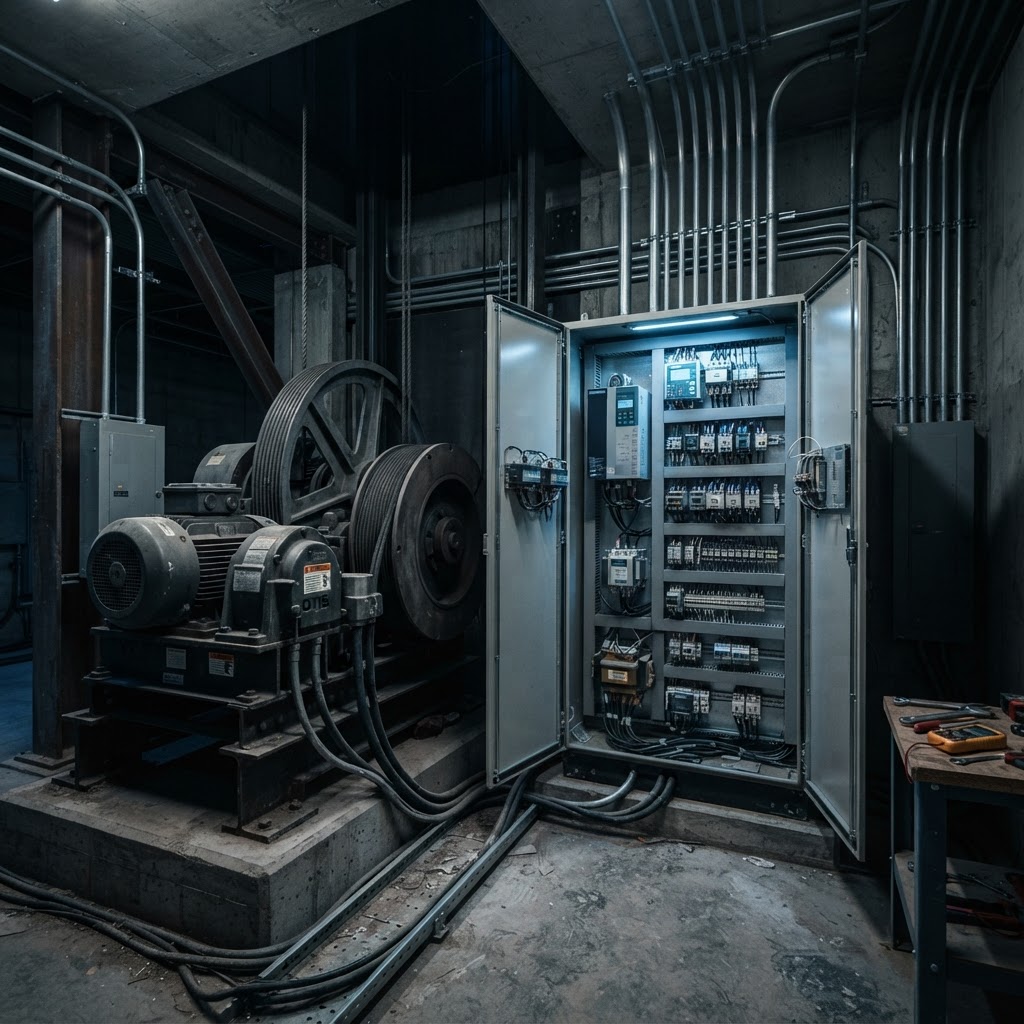
Elevator electrical work happens in four places: the machine room, the controller cabinet, the hoistway, and the disconnect feeding all of it. This is what we work on.
Traction machine, controller cabinet, and the feeder that carries the whole ride.
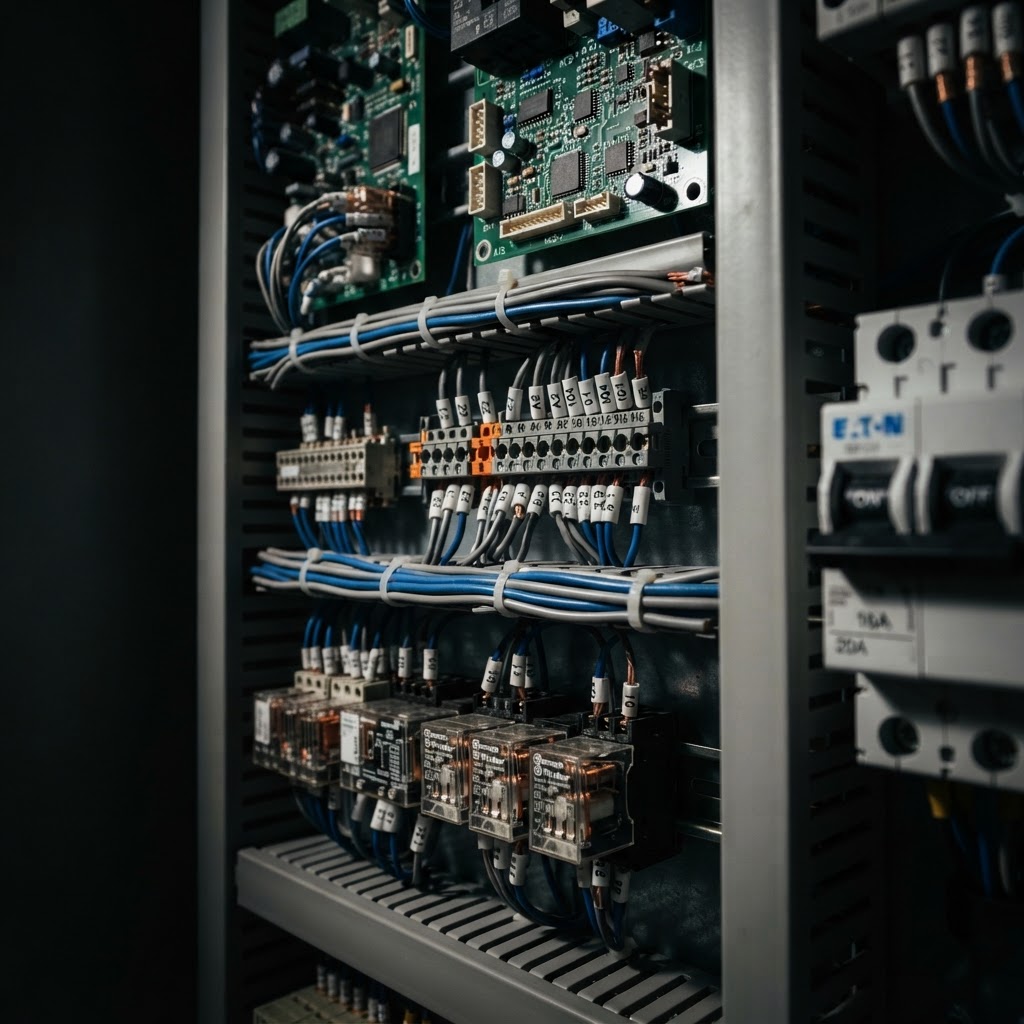
Relay logic, drives, and numbered terminations — where a loose ferrule becomes a stalled car.
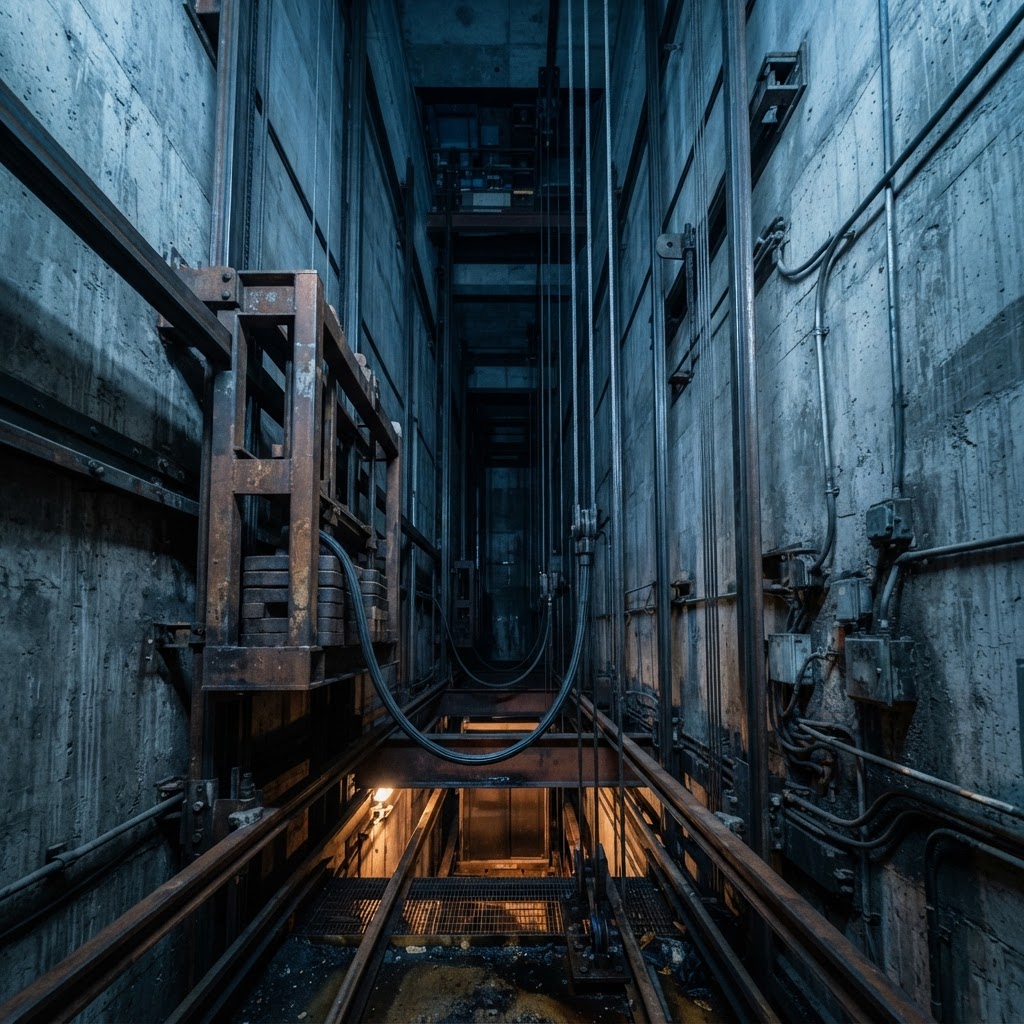
Guide rails, counterweight, and the traveling cable that flexes a million times a year.
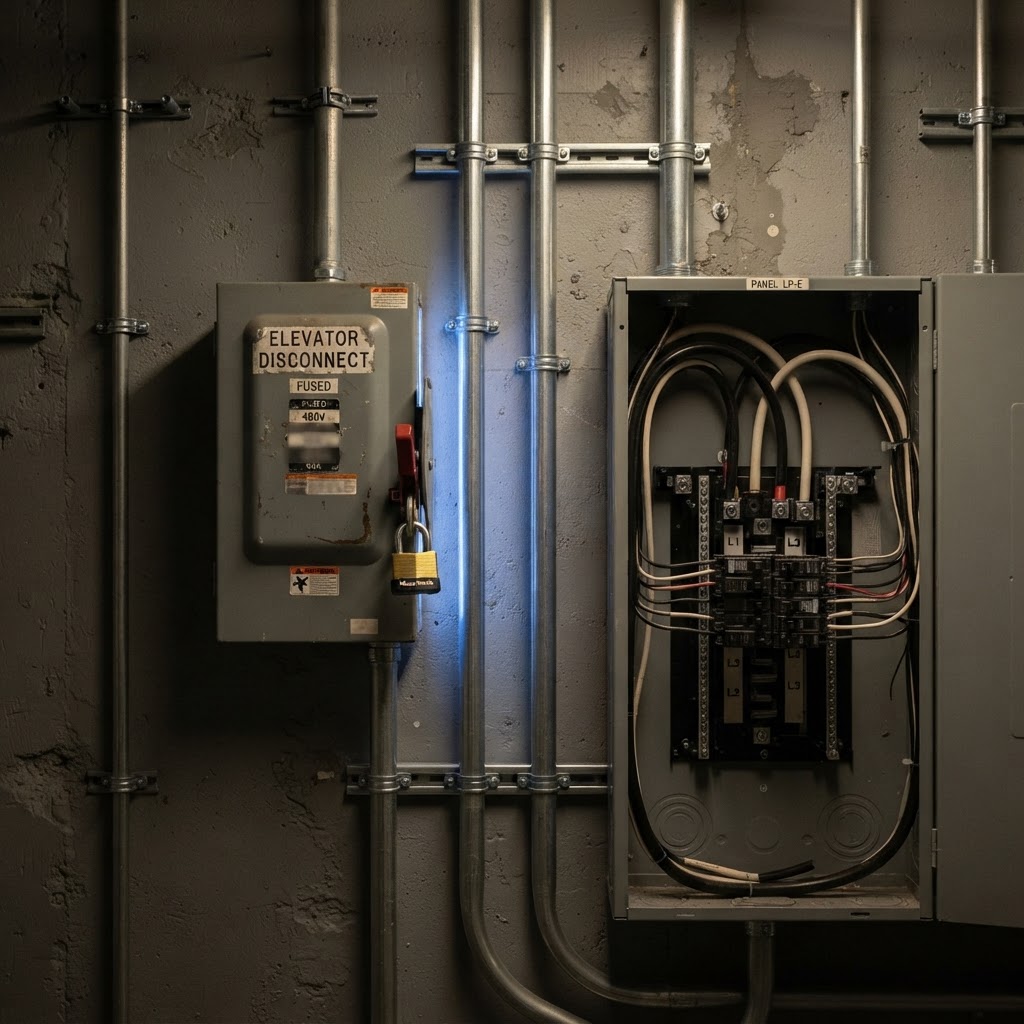
Dedicated feeder and a lockable disconnect sized to the elevator branch circuit.
WHERE THIS CONNECTS
THE REST OF THE SYSTEM
An elevator is never an isolated scope. These are the electrical services that most often come with it — and the pages that explain each one in detail.
COMMERCIAL PANEL UPGRADES
Dedicated elevator feeders, switchgear capacity, and service upgrades when the building's power cannot carry a new car.
LEARN MOREGENERATOR & UPS SYSTEMS
Standby power to the elevator circuit, transfer switches, and battery lowering so riders are never trapped on an outage.
LEARN MOREFIRE SERVICE INTERFACE
Phase I and Phase II recall wiring, hoistway smoke detector interface, and shunt-trip coordination with the alarm contractor.
LEARN MOREELECTRICAL TROUBLESHOOTING
Intermittent stops, drive faults, phantom door reversals — diagnostics for faults that only show up under load.
LEARN MORE24/7 EMERGENCY ELECTRICIAN
Trapped rider, dead car, or a controller that will not reset. Staffed dispatch, around the clock.
LEARN MOREMAINTENANCE PROGRAMS
Infrared scans, torque checks, and documented machine room maintenance on a schedule — before a car goes down.
LEARN MORETENANT FINISH & BUILDOUT
Elevator lobby power, call button stations, cab finishes, and code lighting for new and renovated floors.
LEARN MORESTRUCTURED CABLING
Cab communication, destination dispatch network drops, and monitoring riser cabling for modern control systems.
LEARN MORETO QUOTE THE WORK
WHAT WE NEED FROM YOU
- EQUIPMENT SCHEDULEController make and model, drive type, motor horsepower, voltage and phase, and the number of stops.
- POWER CONDITIONWhether the existing feeder and disconnect are being reused, and what capacity is available at the service.
- SITE ACCESSMachine room access, hoistway condition, and the elevator contractor you are working with, if one is already engaged.
- CODE SCOPEWhether the scope is a new install, a modernization, or repair — each carries a different inspection path.
TALK TO AN ELECTRICIAN, NOT A CALL CENTER
Send the equipment details and we will come back with a scope, a schedule, and a price. If a car is down right now, call — the emergency line is answered by our own technicians.
OR START A MAINTENANCE PROGRAMDIAGNOSTIC METHOD
HOW WE FIND A FAULT THAT ONLY HAPPENS SOMETIMES
A car that stops once a week does not leave a code behind, and a controller that resets itself hides the evidence. We instrument the system instead of guessing at it — the same method on a one-car repair and a full modernization.
LOG FIRST, THEN GUESS
We log voltage, current, and harmonics at the drive over days, not minutes, and read the controller's fault history against it. Most intermittent elevator faults are a power event the building created, not an elevator defect.
SCAN IT UNDER LOAD
Infrared scan of the disconnect, feeder terminations, and contactors while the car is running. A loose lug that never fails at rest shows up in seconds under load — and gets corrected before it becomes a fire or a shutdown.
ISOLATE THE CONDUCTOR
Insulation resistance on the feeder and motor circuit, then ring out the traveling cable and hoistway conductors. When a cable has flexed a million times, the failure is mechanical, and it will not show on a static meter reading.
PROVE THE SAFETY SEQUENCE
We functionally test Phase I and Phase II recall with the alarm contractor and verify emergency power transfer with the car loaded. A safety circuit that has never been actuated is a circuit nobody can vouch for.
THE 3P METHOD
HOW WE DELIVER
ASSESS & CODE REVIEW
Machine room walkthrough, existing feeder and disconnect verification, and a code review against NEC Article 620 and ASME A17.1 for the scope being proposed.
POWER & INFRASTRUCTURE
Feeder, disconnect, branch circuit, and grounding installed to the drive's actual requirements — coordinated with the elevator contractor's equipment delivery date.
TERMINATE & COMMISSION
Controller power, traveling cable, cab fixtures, hoistway circuits, and fire service interface terminated and labeled — with the elevator contractor on site for the drive startup.
TEST & DOCUMENT
Recall sequence, emergency power transfer, battery lowering, and load testing verified, with documentation packaged for the inspector, the building owner, and the elevator service record.
WHY US
38 YEARS OF BUILDINGS THAT COULD NOT GO DARK
Lightning Mobile Electric has been doing commercial and industrial electrical work since 1987 — thirty-eight years, twelve states, four branch licenses, and a portfolio of more than $200M in completed projects for Fortune 500 manufacturers, national facility managers, and government agencies. Vertical transportation sits at the intersection of everything that experience is built on: dedicated power, motor controls, life safety, and emergency systems that have to work the first time they are called on. We bring the same crews and the same documentation standard to a single machine room repair that we bring to a multi-building rollout, and we put our license numbers and safety program on the table before the work starts.
LICENSED, REGISTERED, INSURED
- COLORADO LICENSE
- EC.0101552 · ME.0030199
- TEXAS LICENSE
- ME.576645
- UTAH LICENSE
- ME.123080445-5502
- WYOMING LICENSE
- M-52758
- SAFETY PROGRAM
- OSHA 10 · 30 · 1910.146
- DUNS / CAGE
- 080513384 / 8THW9
VERTICAL FIT
INDUSTRIES WE SERVE
HOSPITALITY & HOTEL
Guest elevators, service cars, and ADA compliance in properties that cannot afford a down car.
READ MOREHEALTHCARE & MEDICAL
Patient and bed elevators on emergency power, with the recall and testing documentation hospitals are audited on.
READ MOREDATA CENTERS
Freight and personnel lifts serving white space, coordinated around concurrent maintainability.
READ MOREWAREHOUSE & DISTRIBUTION
Freight elevators and vertical reciprocating conveyors in high-cycle logistics environments.
READ MOREMANUFACTURING
Heavy-duty freight lifts, industrial controls, and power quality in plants with drives already on the service.
READ MORERETAIL & GROCERY
Multi-stop passenger and service elevators across multi-site portfolios and rollouts.
READ MORE
COMMON QUESTIONS
FREQUENTLY ASKED
AREA OF OPERATIONS
COVERING THE INTERMOUNTAIN WEST
COLORADO · UTAH · WYOMING · IDAHO · OKLAHOMA
Oklahoma
ALSO SERVING
Texas: Houston, Dallas / Fort Worth, San Antonio, Austin, El Paso, Lubbock/Montana: Billings, Bozeman, Missoula, Great Falls/Nebraska: Omaha, Lincoln, Scottsbluff, North Platte/Arizona: Phoenix, Tucson, Mesa, Flagstaff/New Mexico: Albuquerque, Santa Fe, Las Cruces, Rio Rancho/Missouri: Kansas City, St. Louis, Springfield, Columbia/Arkansas: Little Rock, Fayetteville, Fort Smith, Jonesboro